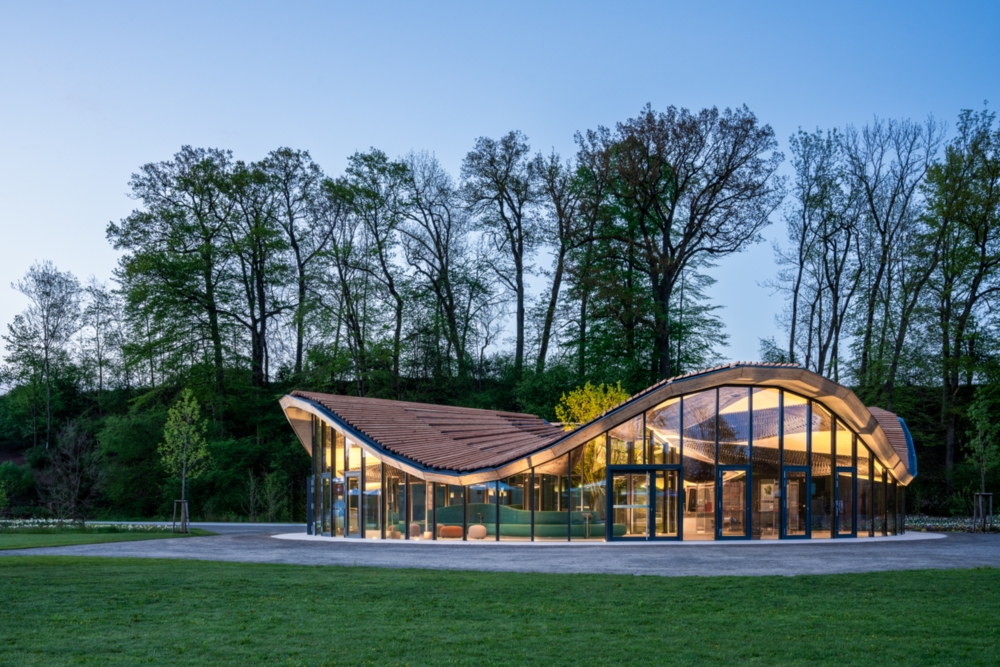
Landesgartenschau Wangen im Allgäu, 2024, Germany
The Hybrid Flax Pavilion constitutes a central exhibition building on the grounds of the Landesgartenschau, located on the winding banks of the recently revitalised Argen River. The pavilion showcases a novel wood-natural-fibre hybrid construction system developed by the Cluster of Excellence "Integrative Computational Design and Construction for Architecture" (IntCDC) at the University of Stuttgart, as an alternative to conventional building methods. The unique hybrid system combines thin cross-laminated timber with robotically wound flax fibre bodies to create a novel, resource-efficient building structure made from regional, bio-based materials with a distinct local connection. Flax was historically processed in the local textile industry, whose old spinning mill was renovated as part of the Landesgartenschau. The pavilion's gently undulating roof, together with its circular floor plan and centrally located climate garden, creates an exhibition space that seamlessly integrates into the surrounding landscape. The geothermally activatable floor slab made of recycled concrete provides year-round comfortable use of the permanent building.
You can find more information on the IntCDC website.


There is a real need, urgency but also opportunity to rethink design and construction in a comprehensive manner, as we can simply not afford to continue building in the way we do now. The lack of digitisation in construction, and the related lack of productivity, together with the significant lack of sustainability can be summarized as a serious innovation shortcoming in the building sector. However, advancing building construction is a complex task and requires profound new methods, as architecture and construction differs substantially from other industries, due to the site-, culture- and context specificity and one-off character of buildings.
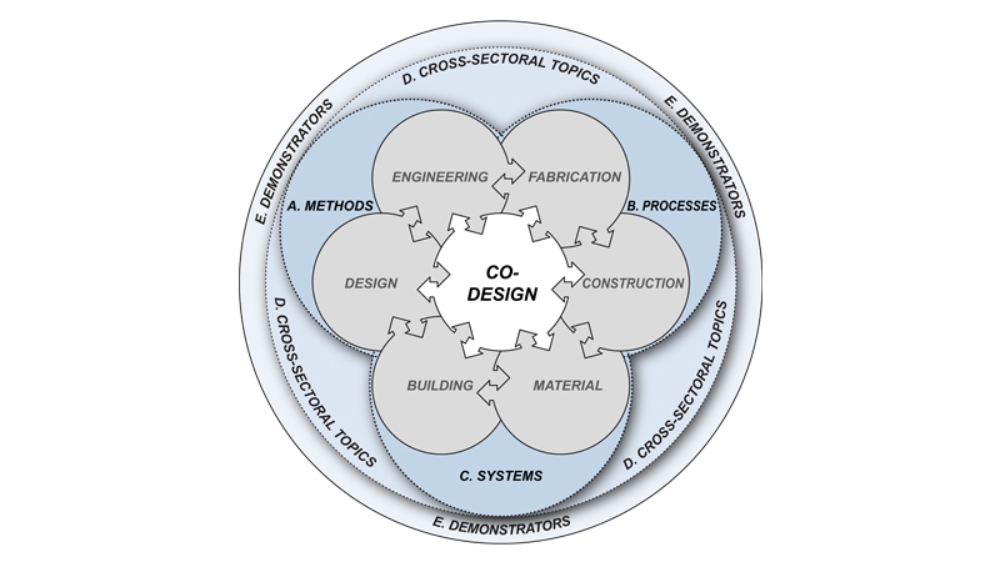
Integrative Research Approach: Co-Design of Methods, Processes, Systems, Cross-Sectoral Topics, Demonstrators
A major obstacle for innovation in architecture and the building sector is the compartementalised nature of research on digital technologies, which separately addresses either the area of design and engineering methods, or fabrication and construction processes, or material and building systems. In order to explore the full potential of computation for ground-breaking advancement, it is vital to adopt an integrative research approach that innovates across all these areas simultaneously. The goal is to develop an overarching methodology of “co-design” of methods, processes and systems, cross-sectoral socio-cultural studies and building demonstrators.
The research approach includes the development of truly integrative computational design and engineering methods, robotic cyber-physical fabrication and construction processes, genuinely digital, next-generation material and building systems and the cross-sectoral critical reflection of integrative and sustainable innovation. The demonstrators enable a rapid turn from visionary research to architectural application.

digitize wood is based at the Cluster of Excellence IntCDC at the University of Stuttgart and is funded by the Baden-Württemberg Ministry of Food, Rural Areas and Consumer Protection (MLR) as part of the BW Timber Construction Initiative.